
Looking for the cost to clean an existing grease trap instead? See our grease trap cleaning cost guide. For large outdoor interceptor pricing specifically, see the grease interceptor cost guide.
Before budgeting installation, confirm your code requirement with our Do I Need a Grease Trap quiz.
Grease trap installation costs $2,000 to $20,000+, depending on size and placement. A small indoor trap runs about $2,000–$5,000 installed; a large outdoor interceptor runs $7,000–$15,000+ once excavation, a concrete pad, and permits are included. Equipment is often the smaller half of the bill — site conditions and labour drive the rest.
Last updated: July 2026 · Reviewed by the GreaseTrapLocator editorial team
Restaurant grease trap installation represents one of the most significant upfront investments for new food service establishments — and one of the most commonly underestimated. Understanding grease trap installation cost before breaking ground saves operators from budget overruns and ensures compliance with local wastewater regulations from day one.
Grease Trap Installation Cost Breakdown by Trap Type
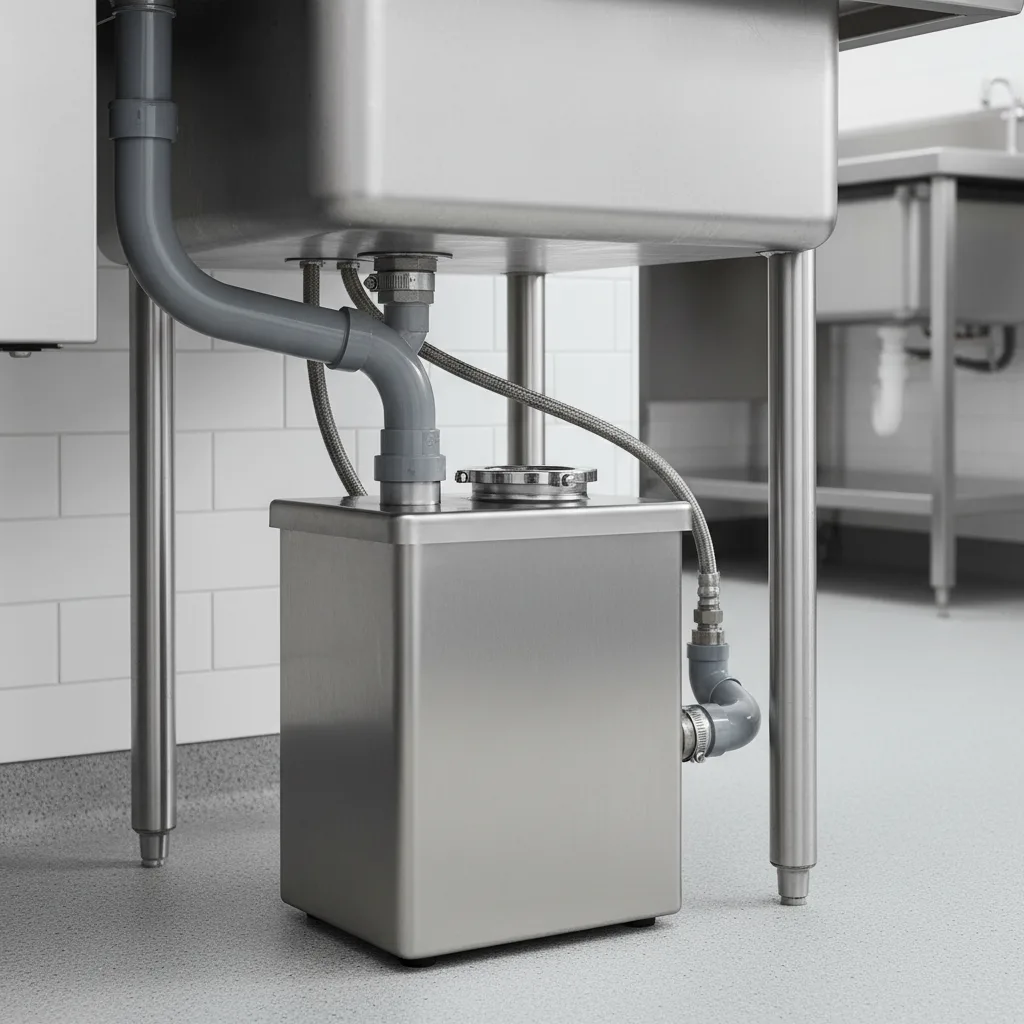
Installation costs vary dramatically based on trap size, placement, and kitchen configuration. Small under-sink models designed for low-volume operations start around $250-$500 for the unit itself, with installation adding another $300-$800 depending on existing plumbing. These passive traps work for coffee shops or bakeries with minimal grease output but fall short for full-service restaurants.
Mid-size indoor traps — typically 20 to 50 gallons — run $800-$2,500 for equipment, with installation costs between $1,200-$3,500. These units suit smaller restaurants and cafes operating single cooking lines. Professional installation includes connection to existing drainage systems, venting, and ensuring proper flow rates that meet municipal sizing requirements.
Large outdoor interceptors represent the highest initial investment. Equipment costs range from $2,000-$7,500 for tanks between 500 and 2,000 gallons, but installation becomes the major expense. Excavation, concrete pad construction, underground piping, and site restoration push total installation costs to $5,000-$15,000 or more. High-volume operations — steakhouses, hotel kitchens, institutional cafeterias — require these systems to handle daily grease loads that would overwhelm smaller traps.
Installation ranges are 2026 planning estimates based on published market rates, contractor quotes, and equipment pricing. Permit and code requirements follow the federal framework of the EPA National Pretreatment Program as implemented by your local authority. Site, soil, and jurisdiction cause wide variation — always get at least three licensed contractor bids.
Installation Variables That Impact Your Final Bill
Location within your facility fundamentally changes installation complexity and cost. Indoor installations require less excavation but demand careful integration with existing plumbing stacks and adequate ventilation. Contractors charge premium rates when installation requires cutting concrete floors, rerouting pipes through walls, or working in tight mechanical spaces.
Outdoor installations involve excavation, which varies by soil conditions and depth requirements. Rocky terrain, high water tables, or contaminated soil discovery during digging can double initial estimates. Urban locations face additional costs for permits, traffic control, and limited equipment access. One Manhattan restaurant operator reported paying $22,000 for a 750-gallon interceptor installation due to sidewalk excavation permits and after-hours work requirements.
Distance from kitchen drains to trap placement directly affects material and labor costs. Every additional ten feet of piping adds $200-$400 in materials and installation time. Proper slope must be maintained — typically 1/4 inch per foot — which sometimes requires cutting through foundation walls or installing lift stations when gravity drainage proves insufficient.
Request detailed installation quotes from three licensed contractors before committing. Ensure quotes specify excavation depth, concrete work, piping lengths, and permit fees — not just equipment and basic labor.
Permit and inspection fees add $200-$1,500 to total project costs depending on jurisdiction. Some municipalities require engineered drawings, which cost $800-$2,500 from licensed professionals. Health department inspections, plumbing inspections, and final occupancy sign-offs each carry separate fees. Budget an extra 10-15% of equipment costs for permitting and compliance documentation.
Hidden Costs That Catch Restaurant Owners Off Guard
Site preparation extends beyond simple excavation. Most outdoor interceptors require concrete pads with specific load-bearing capacities to support pump truck access during routine service. Pad construction runs $1,200-$3,000 depending on size and reinforcement requirements. Skipping this step leads to settling, cracking, and expensive repairs within the first year.
Plumbing modifications rarely appear in initial quotes but frequently become necessary during installation. Outdated drain lines, undersized pipes, or code violations discovered during work require immediate correction. Older buildings may need complete drain line replacement from kitchen to trap location, adding $3,000-$8,000 to budgets. Strategic placement decisions made during the planning phase, as detailed in guidance on where to install grease traps, prevent many of these surprises.
We budgeted $6,500 for our grease trap installation and ended up at $11,200 after discovering our drain lines didn't meet current code and needed replacement. Always budget for the unexpected when dealing with older buildings.
Electrical work becomes necessary for automatic grease recovery units and alarm systems. Running dedicated circuits, installing control panels, and connecting monitoring equipment costs $800-$2,500. Some municipalities now require high-water alarms on outdoor interceptors, adding another $400-$900 for equipment and wiring.
Landscaping and surface restoration after outdoor installation frequently gets overlooked. Parking lot repaving, sidewalk replacement, or lawn restoration adds $1,500-$5,000 depending on affected area size. Urban installations may require restoration to exact municipal specifications, including matching brick patterns or specialty paving materials.
Ongoing Costs Beyond Initial Installation
Installation represents only the beginning of grease trap ownership costs. Regular pumping and cleaning, detailed in comprehensive guides on grease trap cleaning costs, run $150-$500 per service depending on trap size. Small under-sink units need monthly service, while large interceptors require quarterly or monthly pumping based on accumulation rates and local regulations.
Annual maintenance costs include filter replacement, gasket inspection, and flow testing. Budget $200-$600 yearly for routine maintenance beyond pumping services. Neglecting preventive maintenance leads to costly emergency repairs — pump replacements run $1,200-$3,500, while inlet/outlet baffle repairs cost $400-$1,200.
Factor ongoing service costs into your operational budget from day one. Inconsistent pumping leads to overflow violations carrying fines from $500-$10,000 per incident in most jurisdictions, plus potential sewer discharge penalties — federal Clean Water Act penalties alone reach up to $25,000/day under 33 U.S.C. §1319(d).
Compliance documentation and reporting also carry costs. Many cities now require digital monitoring systems that automatically track grease levels and service dates. These systems cost $800-$2,500 installed, with monthly monitoring fees of $30-$75. While optional in some areas, automated monitoring prevents missed service windows that trigger violations.
How to Reduce Grease Trap Installation Costs Without Cutting Corners
Right-sizing your system prevents overpaying for unnecessary capacity while ensuring compliance. Work with experienced contractors who calculate proper sizing based on actual flow rates, number of fixtures, and meal counts — not generic rules of thumb. Oversized systems cost more upfront and increase pumping expenses throughout their lifespan.
Timing installation strategically reduces costs significantly. Schedule work during new construction or major renovations when excavation equipment is already on-site and contractors can coordinate efficiently with other trades. Retrofit installations during business operations cost 20-40% more due to access restrictions, after-hours premiums, and temporary plumbing modifications to maintain service.
| Installation Timing | Cost Range | Key Considerations |
|---|---|---|
| New Construction | $4,500-$12,000 | Optimal access, coordinated trades, lowest cost |
| Major Renovation | $6,000-$15,000 | Shared excavation costs, some access limitations |
| Operating Retrofit | $8,000-$20,000 | After-hours premiums, temporary systems required |
| Region | Small Indoor Install | Outdoor Interceptor Install | What Drives the Difference |
|---|---|---|---|
| Northeast (NY, NJ, MA, CT) | $3,500–$7,000 | $12,000–$25,000+ | High labour + permits, dense urban excavation |
| West Coast (CA, WA, OR) | $3,000–$6,000 | $10,000–$22,000 | Seismic/soil rules, environmental permits |
| Southeast (TX, FL, GA, NC) | $2,000–$4,500 | $7,000–$16,000 | Lower labour, faster permitting |
| Midwest (IL, OH, MI, MN) | $2,500–$5,000 | $8,000–$18,000 | Moderate labour, frost-depth excavation |
| Mountain West (CO, UT, AZ, NV) | $2,500–$5,500 | $8,500–$19,000 | Rocky soil, rural access |
| Canada (ON, BC, AB, QC) | CAD $3,000–$7,000 | CAD $12,000–$26,000 | Provincial permits, deep frost |
Regional installed-cost estimates; the high end reflects urban permitting, difficult soil, and after-hours work.
Material selection offers another cost control opportunity. Polyethylene and fiberglass tanks cost 15-25% less than concrete interceptors while offering excellent durability and lighter weight that simplifies installation. However, some jurisdictions mandate specific materials based on soil conditions or traffic loads, so verify local requirements before specifying equipment.
Combining grease trap installation with other plumbing upgrades spreads mobilization costs across multiple projects. If you're already upgrading kitchen drains or replacing water heaters, adding grease trap installation to the same project reduces contractor overhead and equipment rental expenses.
Frequently Asked Questions
How much does it cost to install a grease trap for a small restaurant?
Small restaurant grease trap installation typically costs $2,000-$5,000 total, including a 20-50 gallon indoor unit and professional installation. Coffee shops and limited-service establishments with minimal grease production often fall toward the lower end, while quick-service restaurants with fryers need larger capacity and more complex plumbing connections that push costs higher. This range assumes standard installation without significant plumbing modifications or challenging site conditions.
Are outdoor grease traps more expensive to install than indoor models?
Yes, outdoor interceptor installation costs 2-3 times more than comparable indoor units due to excavation, concrete pad construction, and underground piping requirements. A 500-gallon outdoor interceptor typically costs $7,000-$15,000 installed versus $3,000-$6,000 for a 50-gallon indoor trap. However, large outdoor interceptors provide significantly greater capacity, longer pumping intervals, and better separation efficiency that reduces long-term operating costs for high-volume kitchens.
Can I install a grease trap myself to save money?
No, grease trap installation requires licensed plumbing contractors in virtually all jurisdictions. DIY installation voids equipment warranties, fails to meet code requirements, and leaves you liable for environmental violations if the system malfunctions. Professional installation ensures proper sizing, venting, and flow rates while providing documentation needed for health inspections and building permits. Attempting self-installation typically costs more long-term when you factor in corrections needed to pass inspection.
What ongoing costs should I budget after installation?
Plan for $1,800-$6,000 annually in pumping and maintenance costs depending on trap size and service frequency. Small traps requiring monthly pumping at $150-$250 per service total $1,800-$3,000 yearly. Large interceptors need quarterly pumping at $400-$500 per service, totaling $1,600-$2,000, plus $200-$600 for annual inspections and minor repairs. Add compliance monitoring fees of $360-$900 annually if your municipality requires automated tracking systems.
How long does grease trap installation take?
Installation timelines range from one day for simple under-sink units to five days for large outdoor interceptors. Indoor trap installation in existing facilities typically takes 1-2 days including plumbing modifications and final inspection. Outdoor interceptor projects require 3-5 days for excavation, pad curing, piping installation, and site restoration. Complex installations with extensive plumbing rerouting or difficult site access may extend to two weeks. Always factor in 2-4 weeks for permit approval before installation begins.
Understanding grease trap installation cost empowers restaurant operators to budget accurately and avoid the compliance violations that result from undersized or improperly installed systems. While initial investment seems substantial, proper installation protects your operation from costly fines, emergency repairs, and the business disruption that follows grease-related failures. Find verified grease trap services in your area at GreaseTrapLocator.com to get accurate quotes from licensed contractors who understand local requirements and deliver compliant installations.
Get Free Quotes from Local Grease Trap Pros
Tell us about your needs and we'll connect you with a verified contractor in your area. Free, no obligation.

Author: Grease Trap Locator Editorial Team
The Grease Trap Locator editorial team covers FOG compliance, grease trap maintenance, and commercial kitchen regulations across the US and Canada. Our guides are written for restaurant owners, facility managers, and food service operators who need practical, accurate information without the fluff.
Find verified, local contractors who handle cleaning, pumping, and FOG compliance — in your area.