
Prepared by GreaseTrapLocator · Fact review: August 9, 2026
Use a project decision sequence
- Identify the wastewater, pretreatment, plumbing, and building authorities that apply to the site.
- Confirm the code edition and amendments actually adopted for the project.
- Document the planned fixtures, routing, expected flow, operating conditions, and site constraints for review.
- Compare only products whose current documentation and listing match the project and the authority's acceptance process.
- Keep the approved design, manufacturer instructions, service responsibility, and required records with the facility file.
The U.S. Environmental Protection Agency explains that local limits can be site-specific. That is why an equipment selection cannot be made from a generic kitchen type, a meal-count shortcut, an assumed installation location, or an unsupported national schedule.
Compare the facts without mixing the measurements
| Decision question | Evidence to review | Do not infer |
|---|---|---|
| What water flow is being evaluated? | The locally applicable sizing method and a named model's GPM documentation. | That a GPM figure equals liquid capacity or grease-retention performance. |
| What product capacity is documented? | The named product's stated liquid gallons and any approved design documentation. | That a gallon figure fixes the appropriate product label or site layout. |
| What performance rating applies? | The named hydromechanical product's listed grease-retention rating and standard references where relevant. | That pounds of grease retention can be converted into liquid gallons. |
| Does retention time matter? | The adopted provision and approved gravity design, where applicable. | That a retention-time statement creates a cleaning calendar. |
For example, Georgia's adopted 2024 IPC amendments identify hydromechanical-interceptor standards and a table with flow and grease-retention ratings. That is an adopted Georgia example, not a national table. The 2024 IPC's gravity definition includes liquid capacity and retention-time elements where the model provision is adopted. Those facts remain distinct.
What named-model examples can and cannot show
Schier GB2-C
This named product page lists 35 GPM, 130 pounds of grease retention, and 20 gallons of liquid capacity. It is useful for seeing how separate measurements can appear in one product record; it does not decide another kitchen's selection.
Schier GB-1000
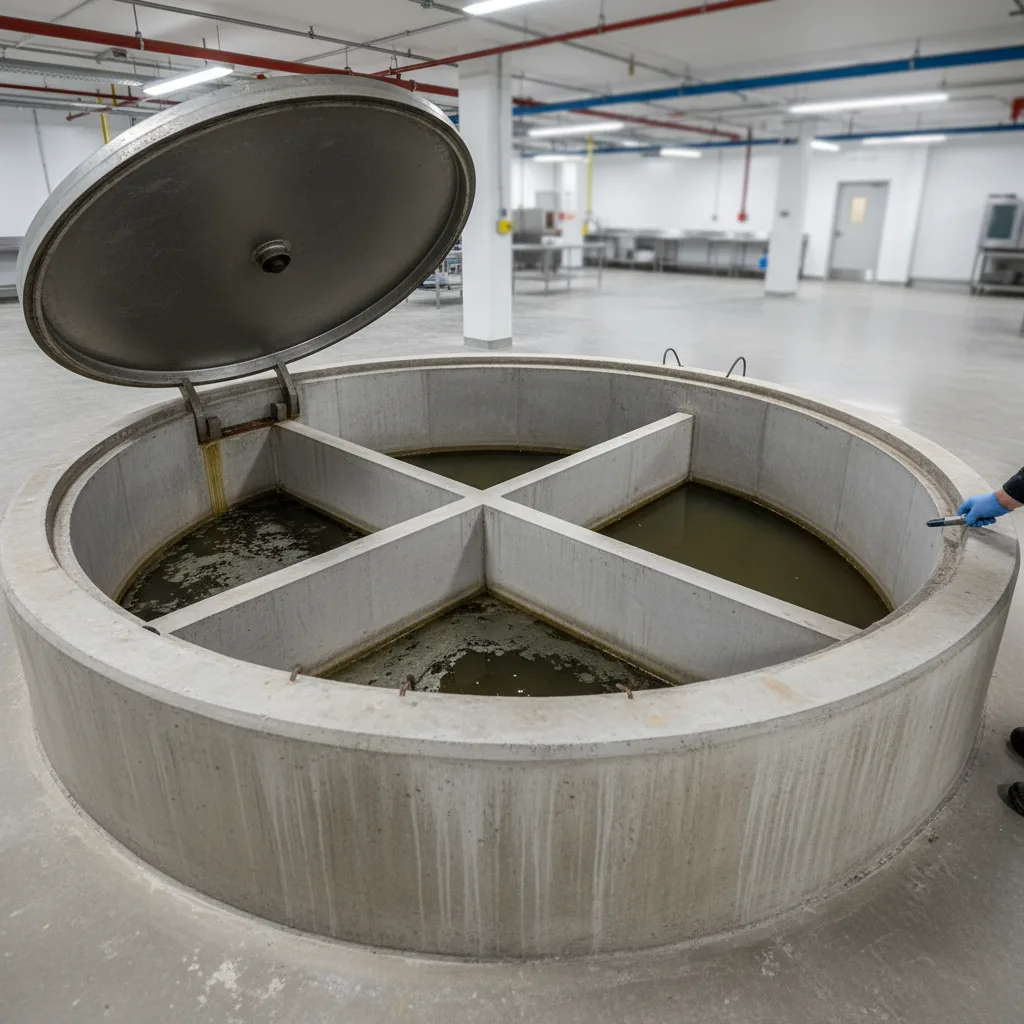
This named product page lists 1,000 gallons of liquid capacity and 100/200 GPM configurations, with several installation configurations. It is a model example, not proof that a location, product class, or tank size is required for every project.
The examples also show why a compact device is not automatically an indoor-only product and a larger unit is not automatically an outdoor-only product. Verify the exact installation instructions, site plan, utility requirements, and approval path for the product under review.
Common language should not override the local rule
The 2024 International Plumbing Code is a model code. It defines gravity and hydromechanical forms under the grease-interceptor term, but it becomes enforceable only where a jurisdiction adopts it, subject to local amendments. The right project question is therefore: which term and which technical provisions does the applicable authority use for this site?
Do not turn model-code language into a general mandate. Do not rely on a product page to establish a permit duty, a worker role, a service interval, or a compliance outcome. Those statements require a current, properly scoped source for the project at hand.
After selection: keep the controlling documents
Once a product is selected and accepted, keep the local program's requirements, approved plans, manufacturer instructions, service records required by the local program, and documented corrective work together. EPA's FOG guidance explains that maintenance frequency depends on the FOG generated and best-management practices; it does not provide one calendar for every facility.
This page intentionally does not give instructions for opening, entering, measuring, or servicing equipment. Use the manufacturer's current instructions, the local authority's requirements, and qualified service direction for the actual equipment and site.
Official sources used
International Code Council — 2024 International Plumbing Code, Section 202
The model code defines gravity and hydromechanical grease interceptors and identifies the gravity definition's capacity and retention-time elements.
Read the Section 202 definitions · reviewed August 9, 2026
International Code Council / State of Georgia — 2024 IPC with Georgia Amendments
Georgia's Chapter 10 provides an adopted example of hydromechanical-interceptor standards and tabled flow and grease-retention ratings.
Read Georgia Chapter 10 · reviewed August 9, 2026
U.S. Environmental Protection Agency — Controlling FOG Discharges
EPA explains that FOG controls can reduce grease before it reaches the public collection system and that maintenance frequency depends on facility conditions and best-management practices.
Read EPA FOG guidance · reviewed August 9, 2026
U.S. Environmental Protection Agency — Local Limits
EPA explains that local limits can be site-specific and can include numeric or narrative discharge limits and best-management practices.
Read EPA local-limits guidance · reviewed August 9, 2026
Schier Products — GB2-C and GB-1000
The manufacturer provides model-specific flow, liquid-capacity, grease-retention, certification, and installation information for these named products.
Read GB2-C product information and GB-1000 product information · reviewed August 9, 2026
Frequently asked questions
How should a kitchen choose between products called traps and interceptors?
Start with the applicable local requirements, approved project design, fixture routing, expected flow, and the exact product documentation. Everyday labels alone do not decide the approved equipment.
Do two products with different gallon figures necessarily serve different applications?
No. A gallon figure is a liquid-capacity measure for a named product. It does not replace its flow rating, grease-retention rating, retention-time requirement, or local project approval.
Can a manufacturer example be used as a single sizing table?
No. Manufacturer documentation is useful for the named model. It should be read with the locally adopted requirements and the project design; it does not establish a single sizing table.
Where can I find the maintenance requirement after equipment is selected?
Use the local wastewater or pretreatment program, the approved project documents, and the current manufacturer instructions. EPA explains that local limits and related requirements can be site-specific.

Author: Grease Trap Locator Editorial Team
The Grease Trap Locator editorial team covers FOG compliance, grease trap maintenance, and commercial kitchen regulations across the US and Canada. Our guides are written for restaurant owners, facility managers, and food service operators who need practical, accurate information without the fluff.
Find local contractors who handle cleaning, pumping, and FOG compliance — in your area.