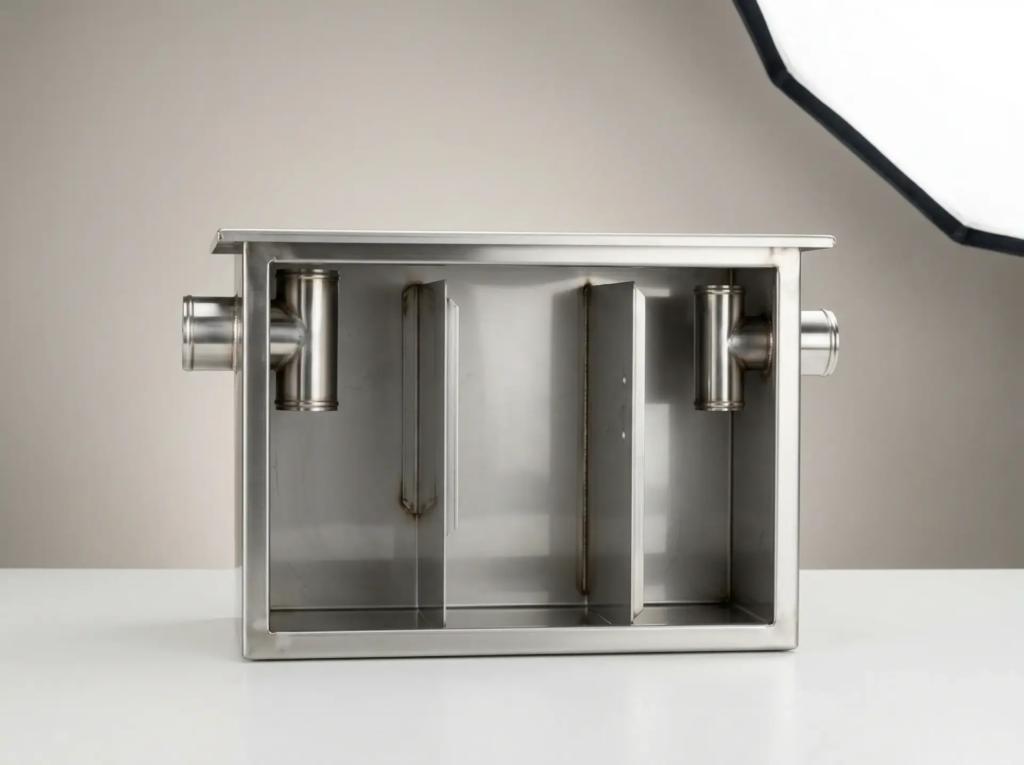

If you're opening a commercial kitchen for the first time — or taking over an existing operation without much background in FOG compliance — you've probably encountered the term "grease trap" in your permit requirements or lease agreement. Here's what it is, how it works, and why it matters.
The Basic Definition
A grease trap — also called a grease interceptor, FOG interceptor, or grease recovery device — is a plumbing device installed in the drain line of a commercial kitchen. Its job is to capture fats, oils, and grease (FOG) from kitchen wastewater before that wastewater enters the municipal sewer system.
FOG causes serious problems in sewer infrastructure. When grease enters the sewer system, it cools, solidifies, and accumulates on pipe walls. Over time, this buildup restricts pipe capacity and causes sewer overflows — raw sewage discharged into streets, properties, and waterways. Municipalities have responded with FOG control ordinances that require commercial kitchens to intercept grease before it reaches the sewer. The grease trap is the primary mechanism for meeting that requirement.
Grease traps are not optional equipment for commercial food service operations. In nearly all U.S. and Canadian municipalities, they're legally required for any kitchen that discharges to the municipal sewer system. For a full overview of compliance requirements, see the FOG compliance guide.
How a Grease Trap Works: Step by Step
The operating principle is simple physics: grease is less dense than water, so it floats. A grease trap exploits this property through a combination of flow restriction and temperature change.
“An undersized trap moves water through too quickly for adequate separation, and grease passes through into the sewer.”
- Wastewater enters the trap from kitchen sinks, dishwashers, and floor drains through an inlet pipe.
- Flow slows significantly inside the trap. Baffles — interior dividers — slow the water's movement and prevent short-circuiting from inlet to outlet.
- Cooling occurs. As the water slows, its temperature drops. FOG, which remains liquid at dishwasher or sink temperatures, begins to solidify as it cools.
- Separation happens. Solidified FOG rises to the surface of the trap. Food solids and particulate matter sink to the bottom. The middle layer — now largely grease-free effluent — remains between these two layers.
- Clean water exits through an outlet pipe positioned to draw from the middle layer, leaving FOG at the top and solids at the bottom inside the trap.
This separation process requires time. Most codes require a minimum retention time of 30 minutes — the time wastewater must sit in the trap before exiting. This is why sizing matters: an undersized trap moves water through too quickly for adequate separation, and grease passes through into the sewer.
Types of Grease Traps
There are three main types of grease interceptors used in commercial food service operations:
Hydromechanical Grease Interceptors (HGIs)
The most common type for small to mid-size operations. Usually installed under a sink or in a floor pit near kitchen fixtures. Compact and relatively affordable, but require frequent cleaning — sometimes weekly for high-volume kitchens — because they fill quickly. Also called passive grease traps.
Gravity Grease Interceptors (GGIs)
Large concrete or fiberglass tanks installed underground outside the building. Appropriate for high-volume operations: large restaurants, hotels, institutional kitchens. They hold significantly more FOG and solids than under-sink units, which means less frequent service (often quarterly), but installation requires excavation and is a substantial capital investment.
Automatic Grease Removal Units (AGRUs)
Mechanized systems that use a skimming mechanism to remove accumulated grease into a separate collection container on a timed cycle. Reduce the frequency of professional pump-outs but require monitoring of the collection container and periodic mechanical maintenance.
The right type for your operation depends on kitchen size, daily water flow, available space, and local code requirements. A licensed plumber familiar with FOG ordinances can assess your situation. For a detailed comparison, see the complete guide to grease traps.
Why Grease Traps Are Required
FOG ordinances exist because of the documented damage grease causes to municipal infrastructure. Industry estimates suggest FOG contributes to roughly half of all sewer overflows in the United States. Municipalities spend significant resources clearing grease-clogged sewer lines. FOG control programs — including mandatory grease trap installation and regular service — are the regulatory response.
Enforcement is typically handled by the local wastewater authority or public works department, not the health department. Inspectors verify that interceptors are installed, properly sized, regularly serviced, and documented. Violations result in fines, required corrective action, and in serious cases, permit suspension or closure.
What Happens If You Don't Maintain Your Grease Trap
A grease trap that's present but neglected provides little protection. Once FOG and solids fill more than 25% of the trap's volume, the separation chamber is too small for effective FOG capture, and grease bypasses the trap into the sewer line.
A grease trap that is present but neglected provides little protection. Once FOG and solids exceed 25% of trap volume, grease bypasses the interceptor into the sewer — and a trap found above 25% at the time of a regulatory inspection is an automatic violation, regardless of when it was last serviced.
The operational consequences: slow drains, sulfur odors in the kitchen, eventually sewage backup through floor drains. The compliance consequences: notice of violation, fines, emergency pump-out requirements. How often to service your trap — and how to know when it needs service — is covered in how often to clean a grease trap and the grease trap maintenance guide.
Frequently Asked Questions
Keep a maintenance log even if your local ordinance does not require one: service date, contractor name, gallons pumped, and manifest number after each visit. This documentation is your first line of defense during a regulatory inspection — and takes less than two minutes to maintain.
What is the difference between a grease trap and a grease interceptor?
The terms are often used interchangeably, but there's a technical distinction. "Grease trap" typically refers to smaller hydromechanical units — the compact devices installed under sinks or in floor pits. "Grease interceptor" more often refers to large in-ground gravity tanks installed outside the building. Both do the same job; they differ in size, capacity, installation requirements, and maintenance frequency.
Do all restaurants need a grease trap?
In nearly all U.S. and Canadian municipalities, yes. Any commercial food service operation discharging to the municipal sewer system is typically required to have an approved grease interceptor. Some very light-use operations — a coffee shop with no food preparation, for instance — may qualify for a variance or waiver, but this requires an application and written approval from the wastewater authority. Assume you're required to have one unless you have written documentation of an exemption.
How do I know if my grease trap is working correctly?
A properly functioning trap handles kitchen wastewater without draining slowly, produces no unusual odors from drains during normal operations, and shows a consistent fill rate within expected ranges for your kitchen volume. Signs of a problem include slow drains, sulfur odors, and greasy water backing up into sinks. A professional service visit includes inspection of baffles and inlet/outlet components — ask your contractor to report any findings that indicate degraded performance.
How long does a grease trap last?
Small hydromechanical interceptors made of stainless steel or durable polymer can last many years with proper maintenance. Large outdoor concrete or fiberglass tanks have service lives of decades when structurally maintained. The components most likely to require attention or replacement are the baffles (interior dividers) and inlet/outlet pipe fittings. Regular professional service includes inspection of these components. Report any structural damage promptly — a failed baffle compromises the trap's effectiveness even when the tank itself is intact.
Find verified grease trap contractors in your area — Search the Grease Trap Locator directory

Author: Grease Trap Locator Editorial Team
The Grease Trap Locator editorial team covers FOG compliance, grease trap maintenance, and commercial kitchen regulations across the US and Canada. Our guides are written for restaurant owners, facility managers, and food service operators who need practical, accurate information without the fluff.
Find local contractors who handle cleaning, pumping, and FOG compliance — in your area.